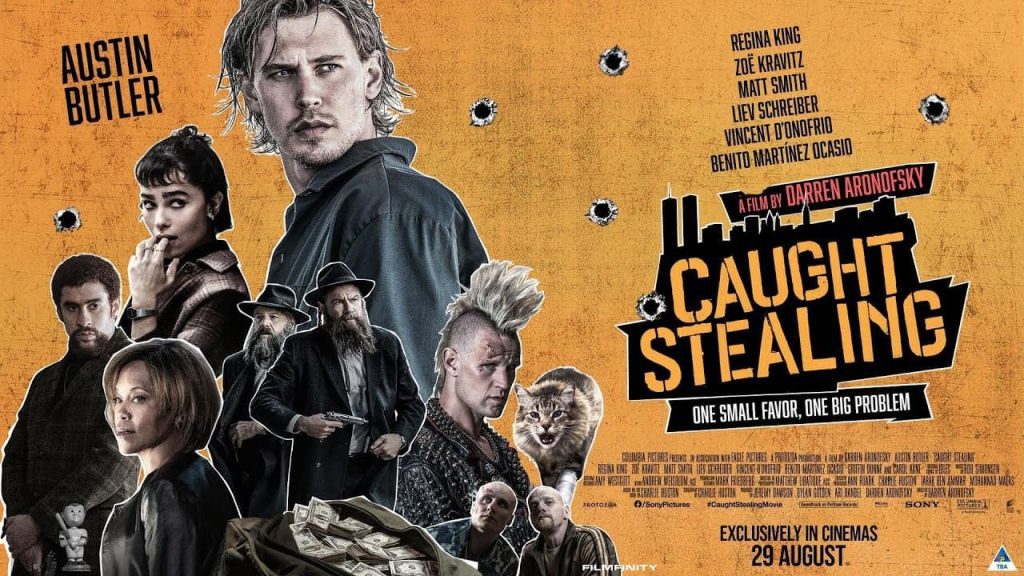

Have you watched Darren Aronofsky‘s latest film “Caught Stealing?” The film represents a bold departure from his typically dark psychological dramas, delivering a kinetic crime thriller that pulses with the raw energy of New York City’s underground scene. The 2025 film, starring Austin Butler, Regina King, and Zoë Kravitz, tells the story of a former baseball player turned bartender who becomes entangled in the city’s criminal underworld while pet-sitting for his neighbor!
What makes “Caught Stealing” truly distinctive, however, is its revolutionary approach to film scoring. The soundtrack, composed by Rob Simonsen and performed entirely by British post-punk band IDLES (pun intened), creates an unprecedented fusion of orchestral scoring and punk rock sensibilities. This collaboration has produced one of 2025’s most talked-about soundtracks, spanning 16 tracks across 44 minutes of intense, gritty music that perfectly captures the film’s chaotic energy.
The partnership between Simonsen and IDLES emerged from a “chance backstage meeting” with Aronofsky while recording an episode of The Tonight Show Starring Jimmy Fallon, proving that sometimes the best creative collaborations happen organically. The result is a soundtrack that breaks conventional boundaries between film score and rock album, creating something entirely new in cinema music.
The Revolutionary Collaboration Behind the Score
Rob Simonsen, known for his work on films like “The Whale,” “500 Days of Summer,” “Love, Simon,” and “Deadpool & Wolverine”, brings his sophisticated compositional skills to this unique project. His previous collaboration with Aronofsky on “The Whale” demonstrated his ability to create emotionally resonant scores that serve the story without overwhelming it.
IDLES, the Bristol-based post-punk band fronted by Joe Talbot, has become one of the most important voices in contemporary punk rock. Known for their socially conscious lyrics and explosive live performances, the band’s involvement in “Caught Stealing” marks their first major film scoring project. Their albums “Brutalism,” “Joy as an Act of Resistance,” and “Ultra Mono” have established them as masters of combining punk aggression with emotional depth.
6th and A
In the Film: Opening the soundtrack and establishing the film’s gritty New York atmosphere, “6th and A” introduces audiences to the Lower East Side setting where much of the story unfolds. This track serves as the musical foundation for the film’s opening sequences, where Austin Butler’s character first encounters the situations that will ultimately spiral out of control. The music combines atmospheric tension with underlying menace, perfectly capturing the feeling of a neighborhood where danger lurks just beneath the surface of everyday life.
Trivia: The title references the intersection of 6th Street and Avenue A in Manhattan’s East Village, a location historically associated with New York’s punk and alternative music scenes. IDLES’ interpretation of Simonsen’s composition for this track deliberately echoes the area’s musical heritage while creating something entirely contemporary. The track features the band’s signature rhythmic intensity but filtered through a more cinematic lens than their typical album work.
Doom
In the Film: “Doom” serves as one of the soundtrack’s most intense moments, accompanying a pivotal scene where the protagonist realizes the full scope of the criminal conspiracy surrounding him. This is one of IDLES’ four original contributions to the film’s score, bringing their unfiltered punk energy to a crucial narrative moment. The track builds from ominous beginnings to an explosive climax that mirrors the character’s growing panic and desperation.
Trivia: “Doom” showcases IDLES at their most aggressive, with Joe Talbot’s vocals conveying a sense of impending catastrophe that perfectly aligns with the film’s themes. The track demonstrates how the band’s political punk sensibilities can translate into narrative storytelling, using their musical language to explore themes of powerlessness and systemic corruption. This is pure IDLES – uncompromising, intense, and emotionally devastating.
Kim’s Video
In the Film: Named after the legendary New York video store that became a cultural institution, “Kim’s Video” underscores scenes that explore the protagonist’s relationship with the city’s cultural underground. The track provides musical commentary on New York’s changing landscape, as gentrification and corporate influence alter neighborhoods that were once bastions of alternative culture. Simonsen’s composition, as interpreted by IDLES, creates a nostalgic yet urgent musical statement about cultural preservation and change.
Trivia: Kim’s Video, which operated from 1986 to 2009, was more than just a video rental store – it was a crucial part of New York’s cultural ecosystem, particularly for film enthusiasts and artists. IDLES’ performance of this track pays tribute to this cultural legacy while also acknowledging its loss. The music combines reverence for the past with anger about what’s been lost, creating a complex emotional landscape that extends beyond the film’s immediate narrative.
Tompkins Square Park
In the Film: This track accompanies scenes set in and around Tompkins Square Park, the East Village location that has served as a gathering place for activists, artists, and outcasts for decades. In the film, the park represents a kind of neutral ground where different elements of the criminal underworld intersect. The music captures both the park’s historical significance as a place of resistance and its current role as a crossroads for the film’s various criminal factions.
Trivia: Tompkins Square Park has been the site of numerous protests and cultural movements, including the famous 1988 riots that erupted over park curfew enforcement. IDLES’ interpretation of Simonsen’s composition acknowledges this history while creating music that serves the film’s immediate narrative needs. The track demonstrates how location-specific music can add layers of meaning to cinematic storytelling, connecting present action to historical context.
Cheerleader
In the Film: “Cheerleader” serves as one of the film’s most emotionally complex musical moments, playing during a scene where the protagonist reflects on his former life as a baseball player. The track creates a bitter contrast between past glory and present desperation, using IDLES’ aggressive musical approach to explore themes of lost potential and masculine identity. The music doesn’t romanticize the past but instead examines how former achievements can become sources of current pain.
Trivia: Critics have noted that “Cheerleader” represents “probably the closest they’ve gotten to Brutalism in years”, referring to IDLES’ acclaimed 2017 debut album. The track showcases the band’s ability to channel personal and social frustration into powerful musical statements. In the context of the film, “Cheerleader” becomes a meditation on American masculine ideals and their ultimate hollowness when stripped of context and community support.
Alphabet City
In the Film: Taking its name from the Lower East Side neighborhood known for its avenues designated by letters rather than names, “Alphabet City” provides the musical backdrop for the film’s climactic sequences. The track builds tension as various criminal factions converge and the protagonist’s situation becomes increasingly desperate. IDLES’ performance creates a sense of claustrophobia and mounting pressure that perfectly matches the visual intensity of these crucial scenes.
Trivia: Alphabet City, comprising Avenues A, B, C, and D, has long been associated with New York’s underground culture and was particularly notorious during the 1970s and 1980s for drug activity and urban decay. The neighborhood’s subsequent gentrification reflects broader changes in New York’s cultural landscape. IDLES’ musical interpretation captures both the area’s gritty history and its current role as a symbol of urban transformation, creating a track that works both within the film’s narrative and as commentary on urban change.
The Punk-Cinema Fusion Revolution
The “Caught Stealing” soundtrack represents something genuinely new in film music – a successful fusion of punk rock aesthetics with traditional film scoring techniques. Previous attempts to bring punk music into cinema have typically involved either using existing punk songs as needle drops or having punk musicians write songs specifically for films. The “Caught Stealing” approach is different: it involves punk musicians interpreting orchestral compositions, creating music that is simultaneously cinematic and authentically punk.
This approach opens up new possibilities for film music, suggesting that the boundaries between different musical genres and cinematic scoring can be more fluid than traditionally assumed. IDLES’ ability to maintain their musical identity while serving the narrative needs of Aronofsky’s film demonstrates that punk rock’s confrontational energy can enhance rather than distract from sophisticated storytelling.
Legacy
“Caught Stealing” may represent the beginning of a new era in film scoring, where the boundaries between different musical genres become more permeable. The success of the Simonsen-IDLES collaboration suggests that other filmmakers and musicians might explore similar cross-genre partnerships, potentially leading to more diverse and innovative approaches to cinematic music.
The soundtrack also demonstrates how punk rock can evolve and expand its influence without losing its essential character. By proving that punk aesthetics can enhance sophisticated storytelling, “Caught Stealing” opens up new possibilities for punk musicians to contribute to different artistic mediums while maintaining their cultural and political integrity.
For film music specifically, the soundtrack suggests that composers and filmmakers should be more open to unconventional collaborations and approaches. The success of this project proves that when the right creative partnerships are formed, the results can transcend the limitations of individual genres or artistic approaches.
The “Caught Stealing” soundtrack ultimately succeeds because it serves the story while also creating something genuinely new in both film music and punk rock. By respecting both the cinematic needs of Aronofsky’s film and the cultural foundations of punk music, Simonsen and IDLES have created a work that enhances both mediums while pointing toward new possibilities for creative collaboration across artistic boundaries.