
Cover Photo by 
This post was brought to you by Robin Hall, the author of Behind the Score. Discover the Harmony Secrets of Modern Film and Video Games.
Master the art of film music composition with everything you need to know about creating impactful scores. Complete Collection Study Pack is currently on sale for 67% off:

“Another lesson I learned during this session was psychological. At one point, I had three violins playing a G note while the other three played an Ab. Because these notes are so close, the players began “leaning” toward each other’s pitch. The G started to sound like an Ab, and vice versa.”
In my opinion, the string section is the backbone of the orchestra. It is, therefore, fundamental for composers to understand how to write effectively for it. Putting theoretical knowledge of composition aside, I aim to address the physical and sonic limitations of string instruments, focusing on writing coherent music that sounds good and keeps your players happy.
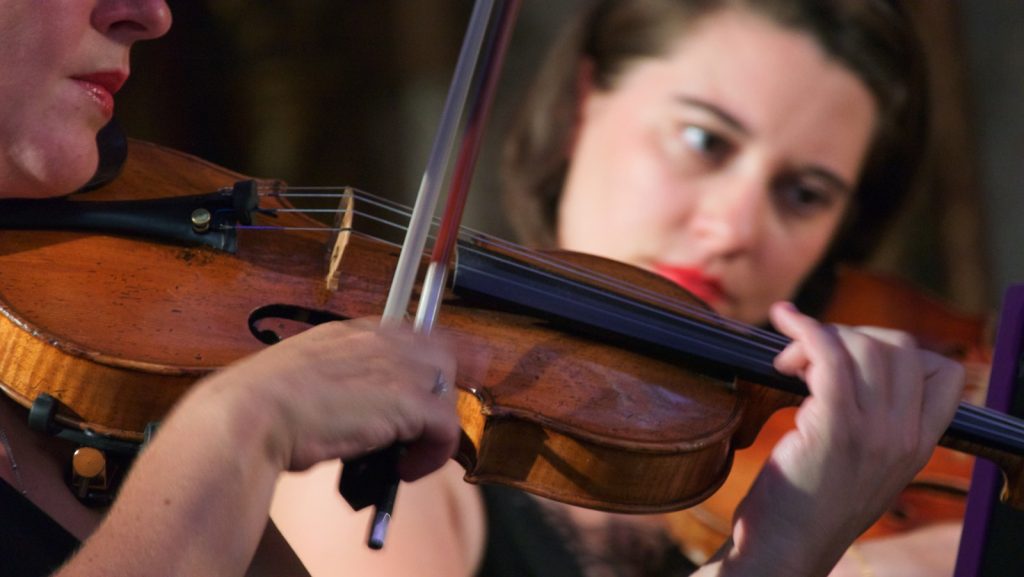
I once faced a situation where I was asked to compose a cue for a short film scene. The director specifically requested tense music that starts small and builds into a climactic finale with maximum dissonance. This wasn’t a full orchestral piece, as I opted to use only six violins, three violas, and one cello. Knowing I’d be working with live musicians for this cue, I paired the instruments carefully to ensure no more than two players were assigned to a single part. My choice to include six violins wasn’t about making the section louder (five violins aren’t necessarily five times louder than one). Instead, it was to control dissonance.
When two violins play the same part in unison, their intonation can slightly differ, creating an unpleasant sound. Because violins are fretless instruments, no two players can play perfectly in tune together. (To clarify, two violins can play in unison, but it requires highly skilled musicians. With amateur players, the results may be less desirable.)
However, when you add a third violin—or more—the sound transforms. You might wonder, “If two violins can’t play in tune, how can three?” The answer is that they don’t play perfectly in tune either. Instead, the combined sound of three or more violins produces a rich, lush tone. The slight pitch discrepancies among players blend into a homogeneous sound, full of warmth, color, and beautiful overtones.
If I were writing for amateur players, I’d adjust my arrangement to suit their strengths. On the other hand, if I knew top-tier session players were performing, I’d confidently write unison parts (though I’d still mark “unison” on their individual sheets for clarity).
Another lesson I learned during this session was psychological. At one point, I had three violins playing a G note while the other three played an Ab. Because these notes are so close, the players began “leaning” toward each other’s pitch. The G started to sound like an Ab, and vice versa.
Since there was no clear tonal center at this moment in the piece, the players began questioning their intonation, resulting in an unconvincing performance. To address this, I reassured them between takes, emphasizing that they should stay confident in their pitch and play with conviction and clarity. If your music is intentionally dissonant, it’s courteous to mention this to the players beforehand and talk through such passages. This builds their confidence and ensures a relaxed performance—especially if you’re not working with top session players.
(If you’re recording at a professional studio or having your music performed by seasoned musicians, a conductor or concertmaster will typically address these potential issues with the performers before the session. However, if you’re organizing and conducting the session yourself, these are essential considerations to keep in mind.)
Finally, while today’s advanced sample libraries allow us to create highly realistic scores in our home studios, we must remember that not everything we write with samples is playable by real musicians. Always ask yourself, “Would this be playable?”
Samples let us push music beyond the limits of live performers, which can be an effective tool in the right context. However, a basic understanding of the instruments you’re writing for will undoubtedly make you a better composer—and much more popular with performers!
Even if you’re not currently working with live players, it’s a good habit to consider playability when writing parts. If you’re unsure, seek out local musicians and talk to them about their instruments. Most will be happy to share their knowledge.
Many of my biggest lessons in orchestration, arranging, and composition have come from working with live players, making mistakes, and receiving their feedback.
I hope some of these lessons will help you on your journey.
This article was written by Robin Hall. Robin Hall holds a double degree in Film Scoring and Jazz Composition from Berklee College of Music. Robin’s music has been featured in campaigns for major films, TV shows, and games, including Top Gun: Maverick, The Black Phone, Ambulance, Aladdin, and Maleficent: Mistress of Evil.
Master the art of film music composition with everything you need to know about creating impactful scores. Complete Collection Study Pack is currently on sale for 67% off: